January 31, 2003
There Is Life after the Elections
This morning’s
news came with the final election returns. After the very last vote was counted,
2 more Knesset seats were gained by right wing parties: Likud is now 38, and the National Religious Party, now 6. The 2 lost seats came from the Arab-Jewish Hadash party and the labor-oriented One Nation. And Labor retained a measly 18 seats in the Knesset.
As if we needed an
illustration of the terrible tidings this bodes, yesterday began with the razing of the Palestinian food market in Hebron. This completes the work of the settlers in this city, whose teenagers would regularly
overturn Palestinian stalls and laugh, a grotesque Israeli version of Hitler Youth, as soldiers look on. In fact, this was the second blow to this market: In 1994,
when the settler Baruch Goldstein gunned down 29 Muslims at prayer in Hebron, the Israeli authorities responded by banning
Palestinians from the street where the previous market had stood. Well, explained
the army after last night’s raid, we did it because 22 Israelis have been killed by Palestinians in the Hebron area
in the last 3 months. What they do not mention is that 155 Palestinians were
killed by Israelis during the same period (www.btselem.org.il ) – 25 in this week alone. And it was not the tomato vendors
who did the killing, anyway.
Is it any wonder
that peace activists would be appalled if the Labor Party joined Likud in a “unity government” coalition, a move
that would shrink the opposition to a mere 33 Knesset members (out of 120)? The
fig leaf that Peres & Co. furnished Likud during Sharon’s first reign undermined decency, democracy, morality, and
any hope for peace, and let the racism genie out of the bottle full force.
Yes, we do feel discouraged,
now that you ask.
Which makes it surprising,
perhaps, that we had a particularly large vigil of Women in Black in Jerusalem today, or a full house at the meeting last
night of the Coalition of Women for Peace. At the meeting, no one wanted to talk
about the election results, though, of course, it was first on the agenda. Instead,
we spent three hours making plans for the coming 6 months: How to get our views
into the media (into the TV, radio talk shows, the newspapers), what kind of message to put on posters that would combat racism
and support a belief in peace, how to deepen the boycott of settler products, and other actions that we plan for the coming
weeks. And in a grand gesture of defiance to the election returns, we decided
to hold a major international event in June – the anniversary of the occupation – to take place simultaneously
in Israel, Palestine, and internationally, linked to each other by video conferencing.
This would allow the voices of Israeli and Palestinian peace activists to finally reach large numbers of people on
the other side, most of whom would be surprised to learn of their existence. Imagine
simultaneous rallies, visible to each other on giant screens, and Israeli and Palestinian speakers declaring live that ‘we
refuse to be enemies’? That would be breathtaking.
I felt better after
last night’s meeting and today’s vigil. And something to recall: Only three short years ago, in 1999, it was the Likud party that earned a measly 19
seats in the Knesset. The political map is not good now, but this government,
too, shall pass.
* * *
February
10, 2003
About Loving Israel and the Jews:
From a correspondence with a Canadian friend
Dear Gila: Congratulations for winning the German PEN Association award. I have a question which I’d
appreciate an answer to. After I sent you the script in which I used your story, you responded by saying you were glad the
story was being used by someone who loves Judaism and loves Israel. I have thought about that since then. Do I love Judaism?
It’s more like Judaism is a part of me like my left hand. There’s parts of Judaism I love, parts I don’t
like at all, parts I don’t understand etc. As far as loving Israel; I have compassion for the Zionist project, but I
cannot say that I love Israel. I have not been to Israel since 1967. I do not like what Israel is doing to the Palestinians.
Why am I writing this? because I want to know, Do you feel that you love Israel? Why?
I’d really like to hear your response. I’m asking this because I am trying to figure out how I will speak
publicly about Israel and in what situations I feel comfortable speaking about Israel. I’m uncomfortable with the litany
of Israel’s sins without contextualizing the Zionist experiment historically. I know you are very busy, but I’d
really appreciate your response.
Helen
Dear Helen, Let me say if I can do this succinctly; it could conceivably take a book. One subject at a time –
I love being Jewish. I suppose that’s different from loving Judaism.
I’m not fond at all of formal Judaism, neither our sources nor our current institutions. I love being Jewish, being part of the Jewish people, which has such a rich and positive tradition of being
on the side of justice and decency for so many centuries. To this very day, Jews
are at the forefront of efforts for peace, justice, humanitarian aid, etc. Our
contribution to world culture & science is immense. Recently, I learned about
the Jewish contribution to peacekeeping in Europe during the middle ages – because they were regarded as neutral, outside
the nationalisms of the warring parties. I love Jews because we are outsiders,
and got to think for ourselves. Is this enough?
I love Israel. Needless to say, I hope, I hate its geopolitical policies over the past 36 years of
occupation, I hate the behavior of its army in the territories, I hate everything our government has done to undermine the
lives of Palestinians, to encourage them to leave this region. I also hate the
fact that the creation of Israel was done at the expense of the Palestinian people, and we have yet to acknowledge that, let
alone seek to make amends. But historically, if you look at the period 1948-67,
you find a lot to love: a little community that worked enormously hard to build
a country that worked, having no previous experience in governance, to create a safe haven after centuries of persecution,
to give warmth and security to survivors of the European holocaust as well as hundreds of thousands of immigrants from the
Arab countries, to grapple with insufficient water, a parched desert over most of the land, and to have created in this otherwise
traditional region, a pearl of beauty and modernity, with wonderful irrigated agriculture, modern homes, excellent roads,
fabulous resorts, and utmost attention to preserving the historical and archaeological sites.
In fact, all this was accomplished even though Israel has almost always been comprised of 50% immigrants at any given
time, meaning that the burden of absorbing these people – providing for their needs – was carried simultaneously
with all the effort required to grow and develop. This is no mean feat! And all this was happening while Israel was teaching itself how to be a democracy,
in a region where this is the exception, not the rule. Needless to say, we have
made lots of mistakes throughout this period, but the overall thrust was one of growth and progress, while caring for the
very needy and troubled souls sought succor here from afar.
The situation after
1967 is clouded miserably by the occupation. I don’t have to expand on
that, I’m sure, as I have nothing but anger and criticism about Israel’s actions in that regard. But if you can step back from our brutal behavior there, you find a country like any other – worse
in some ways and better in others. We’re worse because we’re still
operating in the psyche of being persecuted – that the rest of the world is full of anti-Semitism and can’t be
trusted. This is not uncommon among Jews, and in the case of Israel, it leads
us to behave like the victim rather than the successful country that we are. We
specialize in arms manufacture (and then end up selling it to dictators), we are fanatically competitive in international
sports tournaments, we regard Ilan Ramon as the Israeli hero par excellence, even though his specialty as a bomber pilot is
what made him a holy astronaut, and we demand special compensation about everything.
But on the good side, we are actually, beneath it all, a family, a very close-knit community. Inside this country, I disagree with almost everybody about politics, and refuse to celebrate the national
holidays with anyone but those who share my love-hate feelings, but I know that if I would fall down on the street, everybody
would run to my aid. If I get hijacked by French bandits or fall into a ravine
in Nepal, the Israeli army will go the extra mile to get me out of there and back home safely.
No matter what happens, all of us do share a vision of making this very location a beautiful and safe place –
and one that is morally better than most. I like the fact that I can argue intelligently
with a beggar on the street, because everybody is well-informed and deeply cares. Of
course we will disagree on politics, but we agree that we both love this country, and will argue until our last breath, and
that there is room for both of us in it, no matter what. Yes, the issue of being
exclusionary about Arabs is a grave miscarriage of justice here, and one of the things that the ‘beggar’ and I
would probably fight about.
Helen, I can’t
go on (must get to my work!), but I hope that gives you some sense of why I love Israel and being Jewish. Or maybe love is hard to explain?
* * *
February
28, 2003
The Great Wall of Denial
A few nights ago,
I was awakened at 11 pm by the sound of a loudspeaker blaring from a police car in the street near my home in Jerusalem. I thought I heard a demand for someone to come out of the house and into the street. I wondered if a terrorist was loose in the neighborhood, as had happened more than
once in various parts of Israel. I kept the light off, and ran to confirm that
the front door was locked. Then I turned on the radio to hear if anything newsworthy
was happening in my neighborhood. When I heard nothing, I crept back into bed,
and lay there waiting for the next thing to happen. After a while, I thought
of how many perfectly normal and law-abiding Palestinians are awakened in the middle of the night by loudspeakers from army
vehicles, lie in bed waiting for events to unfold, and end up hearing the sounds of a neighbor being arrested and taken away...or
being taken away themselves. A few weeks ago, a loudspeaker in the village of
Beit Lahiya called residents out of their homes in the middle of the night, and 200 neighbors – including small children
and two women who had given birth 2 days earlier – were forced to huddle together for hours in the cold winter night
until the army let them return to their homes. This is not uncommon in Palestinian
neighborhoods, though the information rarely reaches the newspapers of Israel. In
my neighborhood, it turned out to be the police searching for a missing child. In
the Palestinian neighborhood, it can be a search for someone on the ‘wanted list’… or just plain harassment.
The lives of Palestinians
in the occupied territories have been thoroughly disrupted since Sharon came to power, far more than under any preceding Israeli
prime minister. The mystery, however, is not the reign of terror – this
is no mystery under Sharon – but the indifference of Israeli citizens to that behavior.
How is it possible that through two and a half years of increasingly cruel conduct of our army, the Israeli public
has had almost nothing to say about soldiers...
… urinating
on school computers and defecating on the rugs of homes they have garrisoned for use;
… accidentally
demolishing the homes of innocent people that happen to be near the homes deliberately destroyed
… preventing
the residents of entire cities from leaving their houses for weeks on end (no exceptions – not for chemo, dialysis,
childbirth, buying food, attending school, or visiting your sick mother);
… damaging
27 Palestinian ambulances beyond repair and wounding 187 medical personnel [www.palestinercs.org] ;
… and assassinating
people without the niceties of trial and due process, not to mention reckless shootings in which 126 innocent children aged
13 or younger (including 19 toddlers and infants aged 5 or younger!) have lost their lives [www.btselem.org.il].
Why, I am trying
to understand, are we Israelis so blind to this brutality? Where are the expressions
of revulsion by decent Israelis? Why don’t the major newspapers report
these heart-wrenching stories (not just the liberal and much smaller-circulation Ha’aretz)? Why didn’t a single Jewish political party in the recent election criticize the government for its
policy of collective punishment? Why are the brave young men and women who refuse
to carry out these crimes disparaged in the media, while even Peace Now and the Meretz party don’t come to their support? Why are only a handful of people willing to apply the label ‘war crime’
to the deeds of the army – deeds that merit this designation under any objective reading of the international instruments
of law?
The lack of outrage
and compassion in Israel is difficult to understand. Is it a reflection of the
fact that Israelis are uninformed? Or are they aware and indifferent?
I believe that Israelis
do know the truth. They know because some stories – the most poignant –
do reach the media. A month ago, they saw a scene on Israeli TV of a young boy
on crutches forced everyday to scale a muddy checkpoint wall to get to school. They
know because they do reserve duty in the territories – or their family and friends do – and some even brag about
the dirty tricks they saw or did. They know because some watch CNN, the BBC,
or other foreign media, even when they dismiss these reports as anti-Israeli or anti-Semitic.
But enough stories do get through for Israelis to know what is happening, to understand the brutal reality.
So the question is,
why is there indifference? Here are three reasons, though I’m sure there
are more:
First, the media
gets some of the blame. Although facts and figures are reported, the media fail
to convey the human suffering behind the iron fist policies. Journalist Gideon
Levy points out [Ha’aretz, 2 February 2003] that when 15 Palestinians were killed in Gaza in one blood-drenched
day last week (February 19), the Israeli newspapers were wrapped up in the story of the Qassam shells that landed in Sderot,
wounding one. Journalist Amira Hass speaks of the ‘routine of calamity’
[Ha’aretz, 26 February 2003] in Palestine as disasters spiral, which I believe has also routinized the reporting
of them and our response. When 25 homes were destroyed in Gaza last month, making
200 Palestinians homeless, not a single TV or radio clip conveyed the story of these people with anything approaching compassion.
Second, Palestinian
violence against Israeli civilians provides the cover for Israelis to focus on our own pain and fear, and to frame the pain
of the Palestinians as ‘just desserts’ or an inevitable byproduct of our ‘war on terrorism’. Furthermore, innocent bystanders have been killed on our side, too, making it harder
for Israelis to feel compassion for those they regard as supportive of the attacks.
Nevertheless, the completely lopsided balance of power and suffering has not penetrated the consciousness of the Israeli
public as a whole. The violence on both sides is reprehensible, but most Israelis
behave as if only our people are its victims, while the other side, all of them, are the perpetrators of the crimes.
Third, much blame
goes to our political and rabbinical leaders who engage in fear mongering and dehumanization of the other. Racism is rampant in Israel, from popular Rabbi Ovadia Yosef who called all Arabs ‘snakes’,
to President Katsav who told a group of bar-mitzvah boys, “The Palestinians don’t behave as if they come from
the same planet as we do.” The National Union Party, a member of Sharon’s
new government, openly advocates ethnic cleansing – the ‘transfer’, as they call it, of all Arabs from Israel
and the territories. Is it any wonder that so few pay attention to the suffering
of those who have been devalued and dehumanized? Meanwhile, our military leaders
repeat the mantra that “The IDF is the most moral army in the world.”
There may be many
more reasons for Israeli indifference. Eitan Felner, former Director of the B’Tselem
human rights organization, referred to Israel’s behavior as typical of an adult who has been abused as a child and consequently
becomes an abusive adult, just as Jews were abused in Europe and now take it out on others [International Herald Tribune,
20 August 1998]. Many Israelis believe they hold exclusive rights to the category
‘Suffering Victims’, and are unable to view themselves as having inflicted suffering and victimhood on others.
But the important
question is, how do we penetrate the numbness of Israelis, soldiers and civilians alike, about the wrongness of our actions
– wrong morally and stupid strategically. As virtually everyone has recognized
by now, the brutal policies only create more bitterness and desire for revenge. How
do we get the message across to Israelis that the government is undermining our security in the territories with each act
of humiliation and cruelty? How do we convey to Israelis that we are behaving
in some ways like the persecutors of Jews have behaved from time immemorial?
Israeli peace and
human rights activists have been wracking our brains over how to accomplish this. The
young men and women who refuse to serve in the army have done more than their share to raise awareness about the army’s
cruel deeds, though they face court martial and prison as a result. Led by the
New Profile organization, many peace activists will be holding a rally in April to express our pride in these
young people. Ta’ayush and Rabbis for Human Rights
lead groups of Israelis into the territories to see the appalling conditions.
Machsom Watch takes visitors to the checkpoints to observe the military vise-grip on Palestinians who
try to use the roads. Gush Shalom has led the drive to place the
“war crime” label on unlawful army behavior, to the wrath of the generals and the Attorney General. The Coalition of Women for Peace placed an ad in the Arabic-language newspapers, letting
Palestinians know that some Israelis are aware of their suffering, do care, and are trying to stop it. And a new campaign is shaping up among a coalition of groups under the slogan, “Don’t
say you didn’t know…” in reference to the claims of ignorance by Germans during the Nazi regime. And yet with all this effort, will we be able to break through the Great Wall of Denial?
Something different
works for each person. What caught at my own heart was a scene captured on video
by B’Tselem, an Israeli human rights organization in the territories. It
showed a simple conversation between the B’Tselem fieldworker and a well-dressed Palestinian man, standing forlornly
beside his car parked at a checkpoint:
“Why aren’t
you driving through?” asks the B’Tselem worker.
“I don’t
really know,” answers the man.
“What do you
mean, you don’t know? Aren’t you waiting to get through the checkpoint?”
“Yes, I’m
trying to get to Hebron. But the soldiers told me to wait here.”
“How long have
you been waiting?”
“Since 7 o’clock
this morning.”
“Since 7 o’clock? But it’s 5 pm! Why are they keeping
you?”
“I really don’t
know. I was just driving through and they told me to stop and get out of my car
and wait on the side. I really don’t know.
I’m just waiting for them to let me through.”
After a pause. “Did you eat anything yet today?”
“No, I left
home early and planned to eat in Hebron...” His voice starts to break and
he turns away as he struggles to keep himself from crying.
After a pause. “Did you call your family? Do they
know where you are?”
“Yes, I called
several times, the last time around 3 o’clock, but now my battery is dead.”
“Would you
like to use my cell phone?”
“No, no thank
you, I told them at 3 I’d be home in a couple hours. It’s 5 now. I don’t want to worry them.” He
turns his head and tries to fight the tears.
There is random violence,
there are arrests in the middle of the night, and there are the countless ways to make a person feel powerless, fearful, not
knowing if he’ll get home today or still be standing by his car tomorrow, waiting for the young soldier to let him through.
Indifference is not
felt by everyone. For those who do care, the only answer is to stand witness
to this reality. To share the information with others. To speak truth to power. And, thereby, to break the cycle
of helplessness and despair.
* * *
March
18, 2003
Rest in Peace, Dear Rachel
The media are eager for body counts in Iraq, but the body counts
have already begun in Palestine. Under the cover of world attention riveted on
the events leading up to the U.S. invasion of Iraq, the Israeli army is having its brutal way with the Palestinians. Yesterday,
the army shot and killed 11 Palestinians in the Gaza Strip – including two teenagers and a 2-year old girl cowering
inside her home – and another two in the West Bank. But with all eyes on Bush and Baghdad, is anybody looking at this?
Peace and human rights activists in Israel and Palestine have
been looking, and organizing as well. In the past few weeks, 26 Israeli and Palestinian
organizations have joined together in the Palestinian-Israeli Emergency Committee, to try to prevent just such events from
occurring and worsening. There is no doubt that with the outbreak of war, the
army will impose more prolonged curfews and closures resulting in greater starvation among the already malnourished Palestinian
population. It is also expected that the army will seek to disrupt telephone lines and electricity in the occupied territories.
And a very real danger exists of stepped-up home demolitions, expulsions, and turning a blind eye to settler militias who
attack Palestinians. Activists here will be working to prevent such events, to the extent possible, and keeping the public
informed.
Sunday’s horrifying death of 23-year old Rachel Corrie,
a peace activist from the U.S. with the International Solidarity Movement (ISM) in Gaza, gripped me painfully. Rachel
is the brave young woman who stood in front of the bulldozer, asking with her eyes for the driver to have compassion on the
home he was about to destroy, but he drove directly onto her. And then backed
up to finish the job. I have gone to sleep and awakened with this image in my mind ever since. I did not know
Rachel, but I can only imagine that she herself was so compassionate, that she could not envision the force of darkness about
to envelop her. I shudder to recall similar acts of nonviolent resistance in recent years, which ended only with injuries
and near-misses, and how this killing reveals the hardening hearts of those now giving and carrying out the orders.
*
* *
April 3, 2003
A
Busy Couple of Days
It’s been a
busy day today for Israeli bulldozers. They had to do 16 houses by sundown, and
they couldn’t start until the men who live in them had gone off to work in the morning.
But those machines are tireless, and by the end of the day, you could find 16 families sitting on heaps of rubble,
weeping and cursing. Children, too.
It was also a busy
night for the boys in Tulkarm. That’s the Palestinian town where our soldiers
forced 1,500 men out of their homes in the middle of the night, put them on trucks, and then drove several miles out of town
to dump them out, with orders not to return home ‘for a few days’. And
then the soldiers had to put the town under curfew, just in case the women wanted to go out looking for them.
So now we have several
man-made tragedies of the last 24 hours, but it couldn’t have been very interesting.
Not a photo or even a word about it appeared on the 45-minute TV news tonight on channel 2. Though we did get a very extended item about why the national Israeli soccer team again lost to
France. Now that’s sad.
Three of us women
– Na’ama from the Israel Committee Against House Demolitions, Sylvia from Peace Now, and me from the Coalition
of Women for Peace – had a big argument with one of the bulldozers at Tsur Baher (just outside Jerusalem) this morning. The bulldozer wanted to knock down the house, and we wanted to knock down the bulldozer. Well, actually we just wanted to stop its progress. Our presence standing between it and the house worked beautifully until the soldiers dragged us away along
the rocky, thorny hillside. Thanks to three other activists for their support
and photos.
Here are some remarks
I heard today:
Soldier #1: They have to knock it down – there are terrorists inside.
Soldier #2: No, it’s because they’re building the security fence right here.
Soldier #3: No, it’s because they were built illegally.
None of the above. The homes demolished today were all in one neighborhood, and our best guess is that
this is on the planned route of new bypass road #80.
More remarks, these
directed to the peace activists:
Officer #1: See that? [Palestinians trying to protect
their homes.] You’re inciting them to violence.
Officer #2: Your presence here is illegal.
Soldier: Let go of each other or I’ll cut your arms off.
And now some Palestinian
remarks made to the soldiers:
Villager #1: You better kill us, because if you don’t, we’ll kill you.
Villager #2: See that kid over there? You just turned
him into a suicide bomber.
And a Palestinian
woman who alternately cried and shouted in broken English, “You are animals, where is your humanity, don’t you
have a mother?”
It’s been that
kind of day for the Israeli soldiers. In addition to having to work from dawn
to dusk, and sometimes in the middle of the night, they have to put up with insults and violence.
Oh, and did I mention
that one of those houses destroyed – for the world-record fourth time – was the home of Salim and Arabiyyeh Shawamreh? That’s also the home of Lena, their daughter, who I wrote about 5 years ago
in ‘Lena doesn’t live here anymore’.
Oh, and did I mention
that March was a particularly busy month? 99 Palestinians were killed, 28 of
them children. It’s a good thing it’s April now! Ooops, I spoke too soon. Seven more were killed today, and
still an hour before midnight...
The Israeli army
keeps turning the screws, but, hey, what’s going on in Baghdad?
* * *
May 9, 2003
Support for Human Rights Activists
In order to maintain
its occupation of Palestinian territory, the Israeli government must constantly engage on two fronts – Palestinian resistance
and world opinion. Today’s raid on the offices of human rights activists
will turn out to be another battle lost in the arena of world opinion. And deservedly
so.
In today’s
action, the Israeli army broke into offices in Beit Sahur (a suburb of Bethlehem) and arrested three women – a Palestinian
and two foreign nationals. All three are human rights activists committed to
nonviolence – two are members of the International Solidarity Movement (ISM) and one, a member of Human Rights Watch. All their office equipment – computers, laptops, and cell phones – were
also confiscated.
Is it any wonder
that the Israeli army does not want these people in the territories? They try
to interfere with army actions that violate human rights laws and – even when they cannot prevent them – they
are witnesses to the crime. Arresting and expelling them is an effort at covering
up what the army does not want to be seen.
Here in Israel, efforts
are being made to provide legal support. We ask that you tell elected leaders
that world opinion will not tolerate the silencing of witnesses or the deportation of human rights workers.
Not everyone can
defy a bulldozer. But everyone can raise a voice to protect those who do. Please fax or e-mail the officials listed below.
* * *
May 30, 2003
Searching to End the Lament
Oh, Mother Jerusalem,
You lie there naked with fear,
A mermaid in an enchanted bed,
A wall encircling you,
Burning like a candle from within,
But the houses – locked shut
In loneliness and tears.
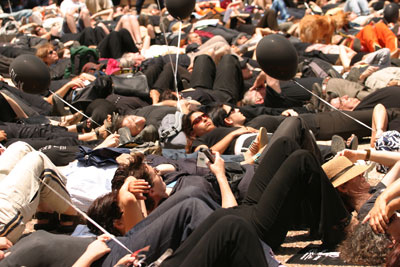
In what may have been one of the most moving
moments of protest in Israel, hundreds of women and men wearing stark black lay down outside the Cinematheque in Tel-Aviv,
completely covering the large plaza in front of the building. At first, it seemed
too hot to attempt such an act – exactly at 12 noon – and first efforts to lie flat on one’s back seemed
a misguided idea. But then the unaccompanied voice of Reem Telhami began its
chant, the haunting harmonies reminiscent of the call of the muezzin during Ramadan at dawn before the sun has risen, and
soon there was utter silence. I lay there, too, the heat pressing against my
arms, back and legs, my eyelids luminescent with sun, and soon I too was inside Reem’s deep, mournful lament. “In loneliness and tears”, she sang three times, each more tender and plaintive than the last. As the last strains evaporated into the air, I could feel my face wet with those tears.
So began today’s demonstration of the
Coalition of Women for Peace, marking 36 years of Israeli occupation, calling for its end and an end to the killing that has
enveloped our lives. How can this still be happening to us? Haven’t 36 years been enough?
The speakers alternated – Jews and Palestinians
from Israel, two Palestinian women from the territories, and one woman representing the internationals who risk their lives
in an effort to intervene nonviolently. Dalit Baum, feminist Jewish
activist, opened by showing the connections among all the forms of violence – occupation, poverty, brutality against
women – through their common roots. Suher abu-Uksa Daoud, a Palestinian
writer doing her doctorate at Hebrew University, spoke of how her own life moved from anger to peace activism. Yali Hashash, a feminist defender of Mizrahi rights among Jews, challenged us to examine our commitment
to justice, and pay a solidarity visit to the protest encampment of impoverished Israelis in Tel Aviv.
Flo Razowsky a U.S. peace activist with
the International Solidarity Movement (ISM), told how the Israeli government is trying to prevent peace and human rights activists
from entering the territories, and noted that she is personally struggling to prevent Israel from deporting her. A particularly moving letter written by Cindy Corrie, the mother of Rachel – the American
peace activist who was killed by a bulldozer as she tried to prevent the demolition of a Palestinian home – was read
out loud and said, in part: “There have been times when I have been quiet
because I felt there were others who knew more. But I am no longer intimidated
by experts and critics. After all, my daughter had the courage to stand in front
of a bulldozer” [full text below]. Shulamit Aloni, former Israeli
cabinet minister and outspoken defender of justice and equality, was eloquent in demanding an end to the bloodshed and the
dawn of an era of peace.
From the occupied territories, Fadwa Khader
of the Palestinian Agricultural Association came to extend her hand in peace. Zahira
Kamal, senior official in the Palestinian Authority, and committed all her life to peace, women, and workers, declared
“I believe in the power of women. Women are grounded in their awareness
of the sanctity of all human beings…I believe we can work together for ending the occupation and that we can live in
peace together.” Rauda Murkus, Palestinian from Israel, closed with
an aching and touching poem.
When all the painful
words were used up, Yana and Haya, our Jewish and Palestinian co-moderators, again asked us to lie down on the pavement, and
I thought we could not recapture that initial moment. But we lay down again,
and Reem began her lament again, and soon I heard a very quiet clapping in response to the weeping in her voice, and a new
space was created together, a space where we met the loneliness and tears of Reem’s singing with the quiet clapping
of our hands. While there was sorrow, we were no longer “locked shut /
In loneliness and tears”.
As the situation in the territories gets worse;
as witnesses are barred from the scenes of violence; as political rhetoric raises expectations and then retracts them; our
hopes still lie with the duet of the people, the lament caressed by quiet clapping, the Palestinians and Israelis who have
kept their faith, who still reach out to each other inside the pain and wait – and work together – for the lament
to end.
May 30, 2003
From Cindy Corrie, Mother of Rachel Corrie
I am so glad to have
the opportunity to write to all of you today: Israeli women (Jews and Palestinians)
and Palestinian women from the Occupied Territories – all of you gathered today in the name of peace, joined by men
who come in that same spirit. I know that there are now many around the world
who have been moved to action by my daughter Rachel’s example – by her bold decision to leave the relative safety
of her comfortable life in the United States and to come to the Occupied Territories and there to bravely, non-violently oppose
the terrible oppression of the occupation; but today I would like to share with you how in the aftermath of Rachel’s
death, our family has been comforted and strengthened by the work that you do and by your example.
When Rachel was killed
on March 16 of this year, e-mail quickly began to pour in from all over the world. Some
of the earliest included ads from Ha’aretz placed by Israeli Jews who understood why Rachel had come to Gaza,
who understood why she stood up to the bulldozer that day, who understood that in her compassionate heart there was love for
all humanity. It was helpful to us to hear from you and to be able to share with
other Americans that there are Jews in Israel who oppose this occupation. E-mail
came from the Occupied Territories, too, from Palestinians who told us that because of Rachel they were making a commitment
to work non-violently for justice. It was helpful to us to hear from you
and to be able to share with other Americans that there are Palestinians in Israel and in the Occupied Territories who live
in the direst of circumstances but who resist non-violently, each day doing the best that they can to care for their families
– to feed, clothe, and educate their children.
In June of 2002, Rachel
wrote in some of her college work, “I think it’s important for people who oppose war and repression to speak about
who we are as a community in addition to speaking about war and racism and injustice.
We are not outside. I think it’s important that human rights and
resistance to oppression be included in the way we define ourselves as a community.”
Through this experience
of losing Rachel, our family finds our community changing and expanding as people reach across town, across the U.S., and
across the world to let us know that they share Rachel’s ideals and that they are moved by her example to work as you
all are doing against war and racism and injustice. Making these worldwide connections
makes it easier to do our work. Hearing about your projects, exchanging e-mails,
talking with you across thousands of miles, gives us courage and determination to go out and speak to Americans. We know that this is not simply a Palestinian-Israeli conflict. This
is a United States-Palestinian-Israeli conflict and Americans need to understand their role in it. There have been times when I have been quiet because I felt there were others who knew more. But I am no longer intimidated by experts and critics and certainly not by the name-callers. After all, my daughter had the courage to stand in front of a bulldozer in order to protect the Palestinian
home of a family with three young children. I have a responsibility as Rachel’s
mother to speak out and to demand that the experts, the policymakers, Congress, and the White House reflect our values –
our beliefs in the sanctity of each life, in the equality of each human being, and in justice and the rule of law.
We cherish our new connections
with the community of Palestinian peacemakers. We cherish our new connections
with the community of Israeli peacemakers. We have since Rachel’s death
visited our first mosque and attended our first services in a synagogue. I believe
that my God and Rachel’s is not only the Christian God – though that is our background and faith – not only
the Jewish God, the Muslim God, or the God of any single religion. I believe
that He/She is a God of us all working powerfully in many of us to create a more loving, saner world. I believe my God will help me somehow to always be connected to the spirit of my daughter – to the
beautiful, loving, magical light that she was in my life. I will do what I can
to work for the community Rachel envisioned. I will remember these words that she wrote to me from Gaza:
This has to stop. I think it is a good idea for us all to drop everything and devote our lives to making
this stop. I don’t think it’s an extremist thing to do anymore. I still really want to dance around to Pat Benatar and have boyfriends and make comics
for my co-workers. But I also want this to stop.
Disbelief and horror are what I feel. Disappointment. I am disappointed that this is the base reality of our world and that we, in fact, participate in it. This is not at all what I asked for when I came into this world. This is not at all what the people here asked for when they came into this world. This is not the world you and Dad wanted me to come into when you decided to have me.
As all of you gather
today and lie down together to mourn all of the Israelis, all of the Palestinians, and all of the Americans who have died
in this terrible conflict, I am with you and I will mourn with you, too. But
I will also cling to Rachel’s words, “This has to stop,” and I will plead with other Americans to join you
in work to make this stop.
Peace to all of you.
Cindy Corrie
* * *
June 4, 2003
Some Lives are Cheaper than Others
Last night in Israel, an evening in memory of
Rachel Corrie was held. Rachel was the 23-year old member of the International
Solidarity Movement (ISM) who was killed by a bulldozer as she stood her ground, trying to protect a Palestinian home from
being destroyed (see www.palsolidarity.org for details).
We were about 200 who gathered in Tel Aviv for
the event, organized jointly by the Israel Committee Against House Demolitions and the Coalition of Women for Peace. Most of us were Israelis, as the closure still keeps out most Palestinians from the
territories. One who did come (sorry I missed his name) spoke on behalf of the
joint effort at Mas’kha to halt the destructive “separation wall” now in construction on Palestinian lands. There was also a handful of activists from ISM and CPT (Christian Peacemakers Team),
though these internationals now rarely cross into Israel, as the authorities would prevent them from returning to their work
in the territories.
Although the evening highlighted the special qualities
of Rachel – an incredible young woman who will continue to inspire us all – many speakers talked about the brutalization
of the Israeli army and Israeli society in general, which no longer cares about the death and destruction wreaked daily in
our name. As a result, the army is no longer held accountable for the shooting
of any non-settlers or soldiers in the territories. Since Rachel was killed,
two more ISM members were seriously injured – Brian had his face blown away and Tom lies brain-dead. Shockingly, the army conducted no investigation into any of these shootings, even though demands were made
on every public, private, and diplomatic level.
Just a few days and several kilometers away from
where Rachel was killed, Nuha al-Mukadame also lost her life – a 33 year-old Palestinian woman who was crushed when
the Israeli army destroyed her home in the middle of the night. Nuha was killed,
her husband and 10 children injured, but the army curtly defended its action – they were targeting the house next door
– and never looked back. Thus it goes for the 2,006 Palestinians killed
by Israelis in this Intifada (www.btselem.org.il) – some deliberate assassinations, some ‘armed terrorists’, and some just
in the house next door.
Israeli soldiers do what they like in the territories,
with no fear of prosecution. The recent efforts to keep out witnesses –
journalists, human rights workers, humanitarian organizations, and peace activists – are not surprising, considering
the desire to hide the evidence. And I tremble to think what happens when these
soldiers return home, well-versed in techniques of bullying and humiliating. This
is not good for anybody.
**********************************
A Letter from Rachel
Corrie’s Parents
To the Coalition of
Women for Peace and the Israel Committee Against House Demolitions
Khalil Gibran said,
“When you are sorrowful, look again in your heart and you shall see that in truth you are weeping for that which has
been your delight.” Rachel was our delight.
As we weep, we try to recall our time with her and try to dwell on all that she leaves us. It is difficult to summarize a life and to put into words what that life has meant to yours, but we hope
we can share with you a bit of the essence of Rachel. From the moment she was
born, she was an essential part of us – her mom, her dad, her brother and sister.
So much of what we miss now, of course, is just having her around – coming through the door to our house into
the safety of a family place where she could just be. She napped on our couches. She relaxed on our deck bathing herself in the welcome spring sunshine. She ate potato soup suppers with us, and sat in front of the fire to warm herself. She sat quietly in corners writing and made messes creating art in the garage. She asked for advice about how to grow plants and wandered through the yard looking at what was emerging
there. She talked us into taking her out for sushi dinners, into buying her tin
boxes at antique shops, and into purchasing additions for her wardrobe at the Goodwill store.
She challenged our political views when they needed challenging. She chastised
us if we weren’t thoughtful enough in our opinions. She playfully teased
us about our many shortcomings and worried too much about her own. She loved
us, and comforted us, and supported us when we needed it. When she hadn’t
seen us for a time she greeted us with long, loving embraces.
Her grandmother writes
of her as an infant, “Rachel would lie with Chris and Sarah stretched on the floor beside her, playing a board game. Games bored me, but here this baby seemed entranced.
I think it was her feeling of connectedness, of belonging, that person-to-person relatedness that was so remarkable
to her. Rachel’s life didn’t touch yours lightly. She impacted you.”
In her fifth grade yearbook
at age eleven Rachel wrote her ambitions: “I want to be a lawyer, a dancer,
an actress, a mother, a wife, a children’s author, a distance runner, a poet, a pianist, a pet store owner, an astronaut,
an environmental and humanitarian activist, a psychiatrist, a ballet teacher, and the first woman president.” .
One of her high school
teachers wrote, “When I consider Rachel’s impact on me the first phrase that occurs is – destined to make
a difference. In my relationship with Rachel as her teacher and friend…there
was a mutual respect for the written word. She was the creator. I was the editor and as a good listener I was a sounding board for Rachel.
She had so many ideas, so many questions…Rachel couldn’t be bothered by little things like turning in all
of her assignments, because she was already dealing with the big issues: splashing
in a puddle on the way to class and then writing poetry that was so clear, so poignant and so articulate one wondered but
didn’t question how this complex young woman had so much to contribute.
One of her faculty at
Evergreen State College in Olympia wrote of her, “She was not content to merely learn about injustice in the world but
also needed to do something about it. This was true locally where she would counsel
low-income people, work to save the Labor Center at the College, or connect art and peace in the Procession of the Species
(an Olympia earth day event that honors all of life).
One of Rachel’s
college classmates wrote, “She had touched us long before all this happened. She
will continue to touch us. There was more to Rachel than that fateful day in
Rafah, thousands of miles away from her home. There is more to her than any one
individual will ever know…There was a greatness in Rachel that can and should inspire the greatness in all of us. If our collective memory of Rachel ends with admiration, then her message is lost
on us.”
We know that Rachel’s
message is not lost on those of you who have gathered today to remember her. We
know you are deeply connected to her in your efforts to end the occupation and to bring peace, justice, and security to all
the people of Israel and Palestine. Tonight, while taking a break from writing,
we attended a meeting here in Olympia to raise awareness of and funds for the Israel Committee Against House Demolitions. We will spread the word in the U.S. Mahatma
Gandhi said, “A small body of determined spirits fired by an unquenchable faith in their mission can alter the course
of history.” We thank you for this evening in honor of Rachel and we join
in solidarity with all Israelis, Palestinians, and internationals – determined spirits – who strive to end the
horror of the occupation and the violence that it brings to us all.
Peace to you from the
Corrie family.
May 28, 2003
* * *
June 13, 2003
A Macabre Alliance
It was a good week for the extremists on both
sides. As they perceived some hope rising last Wednesday in the seaside resort
of Aqaba, they got to work: The very day after all those high falutin’
words, Sharon sent a hit team into the West Bank and knocked off two senior Hamas figures.
So Hamas and allied groups made use of the weekend to kill 5 Israelis in Gaza and Hebron. Tuesday was a big one: Sharon launched Apache gunships at
Rantisi, senior political leader of Hamas. Though Rantisi survived, the funerals
of 2 more Hamas leaders and 6 collaterally damaged men, women, and children helped balance things out. But Rantisi wasn’t down for long and on Wednesday, a suicide bomber sneaked into downtown Jerusalem,
adding 17 more bodies to the count. That evening did not find Sharon idle and,
together with Thursday, he sent the boys back for 9 more killings (counting women and children) in various locations. Hamas got in one more, too.
Is this too confusing? Let’s simplify and say that 42 Israelis and Palestinians were killed these past eight days. It was a good week for the extremists and, as we speak, they are out there frothing
at the mouth and fomenting hatred for each other. (“Now it’s all-out
war”, says Sharon. “Now your women and babies are also targets”,
says Rantisi.)
But while the extremists are having a heyday,
the rest of us – you won’t be surprised to hear – just want the flow of blood to stop:
On the Palestinian side, there is broad support
(63%) for the resumption of negotiations with Israel according to a poll conducted a few weeks ago by Bir Zeit University
(http://home.birzeit.edu/dsp/DSPNEW/polls/poll_12/). While polls also show Palestinian support for
armed conflict, this is always in the context of liberating themselves from Israeli rule.
In fact, an April poll by the Palestinian Center for Policy and Survey Research showed that 71% support the mutual
cessation of violence (http://www.pcpsr.org/survey/polls/2003/p7a.html).
In parallel, most Israelis are fed up with being
occupiers. A poll in today’s Yediot Aharonot, Israel’s most
widely read newspaper (conducted by Dr. Mina Zemach) reveals that 67% of Israelis feel “the occupation is harmful to
Israel”. The same large majority (67%) wants to end the policy of assassinations. In fact, an astonishing 40% believe that the attempt on Rantisi’s life was made
to deliberately thwart implementation of the road map! Isn’t that an amazing
allegation of disingenuousness attributed to Israeli leaders?
So we are left with the lines drawn as follows: On the one side (roughly 30%) are the Israeli and Palestinian extremists, all working
hard at perpetuating the misery of the other; and on the other side (roughly 70%) are the Israeli and Palestinian victims
of their fundamentalist ideologies. These are the real lines of conflict in the
Middle East: the coalition of the willing – the extremists on both sides – against the coalition of the unwilling
– the moderates, which include those who have to take buses (not cars) or are standing in the wrong place as the helicopters
pause overhead.
Today, the second annual gay pride parade was
supposed to have been held in Jerusalem. It was postponed a week because it’s
hard to be gay when you are in mourning. Among the victims of the Jerusalem bus
bombing were Alan, who would have marched in today’s parade; Tamar, whose grandmother and sister are Women in Black
peace activists; Zippi, whose sister is one of the human rights monitors in Machsom [checkpoint] Watch; and 14 other good
people, some of whom probably even believed Sharon when he said he wants peace.
Ultimately, the 30% crazies are going to lose
out to the two-thirds of us who don’t want to be going to the funerals of healthy, innocent friends. In time, the moderates will eventually win out – the extremist Israelis will inevitably give up the
occupied territories and the extremist Palestinians will inevitably give up their demand for driving us into the sea. What makes me furious is that we are in the majority, but our extremists, bound in
a macabre alliance, are galloping together in a race toward each other’s death, and we are getting trampled in their
madness. How much killing must there be before the sane majority has had enough?
* * *
July 26, 2003
A Midsummer Night’s Update
A few peace movement
items before I head off to the Sinai tomorrow for a week’s retreat:
“Realistic
Religious Zionism”
This was a good way
to begin yesterday’s Women in Black vigil in Jerusalem. A group of young,
Orthodox Jews walked by and handed out flyers headlined, “Get down from the hills – return to the people!”,
addressed to the settlers.
I had read about
this movement, founded just a few months ago, but seeing them on the street made it come to life. The short flyer establishes the identity of its writers – all graduates of Israeli religious schools
and movements, and committed to Zionism – and then implores the religious settlers to return to the basic values of
Judaism and...leave the occupied territories.
They call their movement
“Realistic Religious Zionism”, and their website (www.tzionut.org) gives details. The gist in the English version
is: “The fact that the State of Israel is ruling over approximately three million people against their will, while denying
them their basic rights, arouses severe moral problems...We hereby call upon the Religious Zionist public to recognize the
necessity of relinquishing our rule over the Territories and turn its efforts to dealing with the urgent problems affecting
Israeli society in general, and the religious public in particular.” May
the movement be fruitful and multiply.
Polling the
Settlers
Last Wednesday’s
Ha’aretz (July 23rd) carried a second encouraging poll of the opinions of settlers (conducted on behalf of Peace
Now). This year, again, the conclusion is that settler political views are “far
more moderate than usually perceived”, and that settlers, therefore, are not an obstacle to peace.
For years, settler
leadership has been threatening that “Uprooting settlements will lead to civil war” (a poster visible throughout
Israel). This is a scare tactic they have adopted to prevent moderate folk from
supporting settlement evacuation. Well, it turns out that 90% of the settlers
say they “would not break the law” to oppose evacuation and only 1% (compared to 2% last year) would use violence
to prevent being evacuated. Oh, and about that leadership: only 12% say that
the official settler leadership (the “Yesha Council of Settlements”) actually represents their views.
About the Ceasefire
(Hudna)
Although both the
Palestinians and Israelis have mostly kept the ceasefire (with some exceptions), the situation in the territories remains
unchanged: poverty, unemployment, and the same old obstacles about moving from one place to another. Israel has not eased the closure or checkpoints even one little bit, and that continues to place a crushing
weight on daily life – jobs, schooling, health, etc.
No, we are not talking
about security here. If security were the only consideration, most of these checkpoints
would be dismantled. There is no security need for Israeli soldiers to search
Palestinians who are entering their own towns or villages. There is no security
reason to prevent Palestinians from crossing their own fields to get to the next village.
Traveling with a B’Tselem fieldworker last week, I saw settlers whiz through the checkpoints as if they didn’t
exist, while Palestinians waited in the burning sun for hours as the soldiers looked through their documents and packages. Palestinians are also barred from traveling on many of the roads. Short trips turn into hours-long sagas. This isn’t about
the safety of Israelis. This is about showing Palestinians who’s boss.
The Separation
Wall
I was relieved to
hear George W. Bush call it a ‘separation wall’ and condemn it. The
Israeli government calls it a ‘security fence’, trying to tone down its immense size and ascribe to it powers
of ‘security’ that it does not have. This wall commits two cardinal
sins, as I see it: First, it is being constructed inside Palestinian territory,
and not on the original border between Israel and Palestine. This means that
Israel is grabbing more land, destroying more homes, and cutting off more Palestinians from their property and land. B’Tselem estimates that the wall will directly harm at least 210,000 Palestinians. (Several Palestinian towns will actually be surrounded by this wall.) Second, the area adjacent to the wall will probably be declared an ‘open-fire
zone’, thereby endangering the lives of anyone who approaches it. Who needs
an open-fire zone in your backyard?
Check out the B’Tselem
website for details (www.btselem.org.il) and tell George W. that you think this wall is a major obstacle to peace.
We need to offset the campaign to support it.
Vicky Knafo
The neo-cons have cast their shadow over Israel, too, and our new economic reform is, wouldn’t
you know it, good for the rich and bad for the poor. Vicky Knafo, a gutsy single-mother
who walked into Jerusalem from her home in the Negev, managed to inspire dozens of Israelis to do the march and join her at
her encampment opposite the Finance Ministry (now headed by Bibi Netanyahu, former Prime Minister). Those joining have included not only other down-and-outers, but also contingents from both the peace and
the social justice movements. These movements are finally building bridges to
each other after many years of working in unproductive isolation. A spur-of-the-moment
feminist conference, in which all the women’s organizations are participating, has been called for next weekend in the
park adjoining Vicky’s encampment. Bring your sleeping bag, your listening
skills, and at least one practical idea.
But me, I plan to be snorkeling in the Red Sea and little more.
Can’t wait.
* * *
September 6, 2003
Of Assassination and Dialogue
Off with their heads!
While a bunch of Israeli and Palestinian women
were hugging and kissing outside Tulkarm today, the Israeli government dropped three 250 kg (550 lb) bombs on an apartment
building in Gaza, trying (unsuccessfully) to kill the ten Hamas leaders meeting inside.
“We were only trying to send them a message,” said the news commentator on Israeli TV tonight. “We were trying to kill them,” corrected the anchor, “but screwed up.”
Meanwhile, Abu Mazen resigned and Israelis have
begun “the countdown” to quote more TV talk, on the life of Arafat.
Will Israel finally make the kill or not? All agree that it’s only
a matter of time.
This kind of chatter about extra-judicial killing
– this year alone, Israel has assassinated 110 Palestinians, during the course of which it killed another 73 unlucky
bystanders – goes on in a country which does not have capital punishment. But
that’s a technicality.
A better tale from Tulkarm
Tulkarm is a Palestinian town in the West Bank
on just the other side of the Green Line (1967 border) and one of the victims of the infamous Separation Wall now being constructed. This terrible wall has already trapped 12,000 people between it and the Green Line,
cutting them off from their communities, and has stolen the land, olive trees, and water sources from tens of thousands of
others. We went there today to call for an end to its construction, and for Israel
to leave the territories altogether.
We were 500 women – half gathered on the
Palestinian side of the Tulkarm checkpoint, and the other half on the other side (I almost wrote “the Israeli side”,
but the checkpoint is actually inside the Occupied Territories). On both sides
were a large but uncounted number of “international” women – those who come from other countries to help
us get to peace in the Mideast.
The demonstration had been organized by the Coalition
of Women for Peace, on the Israeli side, and the women of the Tulkarm branch of the People’s Party, on the Palestinian
side. We were also joined by multi-national contingents from CPT and the Ecumenical
Accompaniers – Christians doing peace work in Palestine; Code Pink – the U.S.-based women’s protest organization;
and individual women (and a few men). Buses came from throughout Israel.
At the checkpoint, we could see the group on the
Palestinian side, roughly 50 meters (about 150 feet) away. Both sides held signs
calling for an end to the Wall and the root cause of the conflict – the occupation.
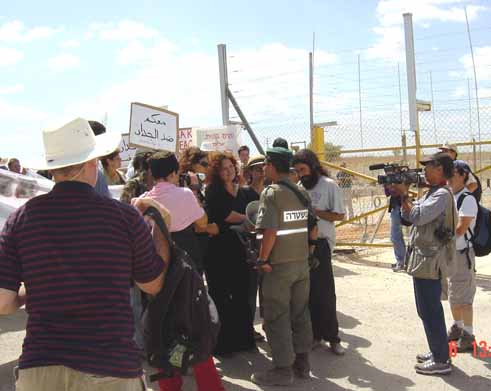
As we approached the checkpoint, we were rebuffed by a group of soldiers, clearly angry at our presence and signs. Within seconds of our reaching them, they pushed and then struck several of our group
– aiming for the men, but also catching some of the women who sought to get between them. Their officers arrived quickly and managed to stop their blows, but a moment later we saw a teargas canister
explode near the Palestinian side. We were relieved that the Palestinians did
not scatter, and no further shots rang out. The women remained firmly in sight
across the military domain.
A pre-arranged group of women approached the officers
on our side to negotiate our passage across. Matters had flared much too quickly,
and our negotiators spoke calmly, explaining our peaceful intentions in meeting with Palestinian women. Our case seems to have been buttressed by 10 very large cartons that we had brought for the women –
school supplies for Palestinian children. After talking and talking and making
us wait in the hot sun, satisfying themselves that they had displayed their control over our movements, the officers gave
permission for 30 of us to cross the checkpoint and meet the Palestinians.
I was one of the lucky ones to go across, and
when we reached the other side, there was hugging and kissing, although most of us did not know each other. Battery-powered megaphones allowed both sides short speeches: “We share your hatred for the wall,
your desire to end the occupation and launch an era of peace,” and “We welcome you to our town, we thank you for
the gifts for our children, we view ourselves as sisters in the struggle for peace”, followed by brief flute playing
and a few rounds of songs that never quite got going. We were all a little shy
after the first outburst of emotion.
I watched the cartons get piled inside and out
of one small, dilapidated car that drove off toward town, where I imagined eager little hands would rip off the plastic and
find a colorful schoolbag inside, filled with notebooks, pencils, colored pencils, an eraser, sharpener, and ruler. And perhaps their parents would read them the letter in Arabic that we inserted into each bag: “We, Israeli women, send this to you with good wishes for a successful school year, and the sincere
hope that your studies will not be interrupted by bullets or tanks.”
Then we all went home and listened to the news,
made by people who spend their time planning encounters of another kind.
At the Italian Riviera
It was good to get recharged last week at the
International Women in Black Congress held in Marina di Massa, Italy, where 400 women from dozens of countries shared their
pain and their strategies. Despite the heat and intense humidity, there was nothing
limp about 4 days of sessions among women peace activists. In addition to contingents
from all the European countries (including a busload of 50 women from the Balkans), women actually managed to arrive from
Iraq, Afghanistan, Colombia, Palestine, and other war-torn regions. Two demonstrations
capped the events – one outside a US army base in Italy, where the soldiers fervently concentrated on their softball
to avoid looking at our anti-war signs outside the gate. And the other at the
resort town of Viareggio, to remind vacationers that sunblock prevents only some problems from getting through. They didn’t look interested.
* * *
September 19, 2003
Sharon, With Eyes Wide Open
The other morning at 7 a.m., I joined Peace Now
for an early morning demonstration to ‘wake up’ Ariel Sharon to the fact that his policy of assassinations only
feeds the cycle of violence, and does not end terrorism.
“You’re making a terrible mistake!”
said our signs, “Your decisions will only create further havoc!” And
yet, it turned out that few of us actually think that this policy is a mistake at all.
Questioning the 5 or 6 people standing near me, I discovered that all of us really believe that Sharon’s moves
are the product of deliberate policy – that they are carried out in the full knowledge that further death and destruction
in Israel would be an inevitable result.
Here is a partial list of Sharon’s decisions
that are usually referred to by critics as policy blunders because of their unwelcome consequences:
Targeted
assassinations and attempted assassinations, even during the recent ceasefire, which provoke increased terrorist activity;
Failure
to support the moderate abu Mazen by meaningful confidence-building measures, thereby leading to his downfall;
The
decision to sideline and then ‘eliminate’ Arafat, whether by expelling or killing him, knowing that, dead or alive,
chaos and instability would ensue, thereby delaying indefinitely any peace negotiation until the regime stabilizes and an
alternative leader emerges;
Rejection
out of hand of the new ceasefire proposal; and
Excessive
force against the Palestinians at large – limiting access to health, education, and employment, ongoing house demolitions,
curfews, harassment, etc. – all of which only serve to fan the flames of bitterness and hostility among the population.
The consequences of these acts seem so dire, commentators
cannot believe that Sharon would deliberately pursue them. But analysts have
begun to add things up, and some have even begun to alert the Israeli public to the deliberate nature of these moves. Writes Zeev Sternhell in Ha’aretz (12 September 2003):
“There’s no reason
to complain to the prime minister and the defense establishment. The present
policy is exactly what Ariel Sharon, the chief of staff, the government, and the settlement leaders think is correct and desirable. They know this policy has a price and they are willing to pay it with eyes wide open.”
The price?
More death and destruction inside Israel. Then why would the prime minister
of Israel agree to this price?
Sharon rode into power on a double promise: security
and peace. And yet Sharon has not made even one significant act of progress
to achieve either. On the contrary, security and peace appear to be the victims
of Sharon’s overriding agenda: maintaining the occupation. Although
one can deliberate Sharon’s motivations for wanting to maintain the occupation – a commitment to a Greater-Land-of-Israel
ideology? a belief that Israel is in even greater jeopardy without control over
Palestinian lives? a hunger for power that feeds off fear of the other? Regardless of the reason, one thing is crystal clear:
All the abovementioned, so-called ‘errors’ are blatant instances of making occupation the priority, placing
it above security and peace.
If maintaining control over the territories is
viewed as Sharon’s priority, then all his actions fall into place. Here
are a few of Sharon’s impressive accomplishments after only two and a half years in office:
He
killed the Oslo Peace Process (a course begun by Netanyahu).
He
exponentially increased the fear and loathing of Palestinians among Israelis (which had declined during Oslo days).
He
brought the Palestinian economy to ruin.
He
resurrected Arafat’s power and influence among Palestinians by appearing to ostracize him.
He
continues to delay construction of a ‘Security Wall’, because it would de facto create a Palestinian state on
the other side of it. And,
He
increased support for settlements by forming the most right-wing government in the history of Israel.
These ‘accomplishments’ all lead to
the same conclusion: a dead end to all avenues leading to reconciliation. Sharon’s
efforts have destabilized Palestinian society economically and politically, dehumanized Palestinians to an extent not seen
even in pre-Oslo days, and destroyed or disrupted all infrastructure that would enable a properly functioning Palestinian
society – roads, power and water supplies, health and education systems, even the records and databases. Sharon has sown chaos and misery, and, above all, has kept the Palestinian population in a constant state
of turmoil. His scorched earth policy is not a mistake, but a deliberate strategy
to grind the population into submission, to prevent the rise of a sovereign state, to allow Israel to continue its domination. And if these cruel measures give rise to belligerent, anti-Israeli activity, all the
better. Palestinian terrorism is what gives legitimacy to Israel – both
domestically and internationally – to maintain its brutal boot on the neck of ‘out-of-control Palestinians’.
A recent Ha’aretz editorial (14 September
2003) called the resolve to eliminate Arafat “a stupid decision” and remarked, “Once again the government
has failed to fathom a reality that any reasonable person readily grasps.”
Is Sharon really stupid, with no grasp of the
consequences of his actions? Please.
It is not time for Sharon to wake up, but for the rest of us to open our eyes.
It is not Sharon who fails to grasp reality, but those of us who buy into his words and fail to account for his deeds. Sharon is deliberately leading the Palestinians into a state of chaos because it leaves
Israel in control…and Sharon in power.
Twenty years ago, the prestigious Kahana Commission
of Inquiry, empanelled by the government of Israel, found Ariel Sharon indirectly responsible for the massacre of Palestinian
refugees in Sabra and Shatila, forcing his resignation as defense minister, and urged that Sharon never serve a senior security
function in Israel ever again.
The Kahana Commission was right. Wake up, everybody!
* * *
September 24, 2003
A Great Gift for the New Year
Here is the best gift imaginable for Rosh Hashana, the Jewish
New Year, which begins this Friday: The refusal to serve of 25 Israeli Air Force pilots. To understand why this event will
shock Israelis in the morning newspapers, you have to know that Air Force pilots are the heroes of Israel, epitomizing the
best, brightest, and bravest. Below is my quick translation of the internet article
prepared by Yediot Aharonot, Israel’s largest circulation newspaper by far. It
gives much more insight than the dry Ha’aretz article. Read it and savor the impact that this will have, undermining
support for the occupation.
This letter is a blessing. May it catalyze a speedy end to the
occupation, and presage the dawn of reason and, ultimately, peace. In the Middle East and everywhere.
From Ynet, of Yediot Aharonot:
Air
Force Pilots in Reserves: We Refuse to Attack in the Territories.
Pilots in Reserves
and Air Crew sent the following letter today to Air Force Commander, Dan Halutz: “We are opposed to carrying out attack
orders that are illegal and immoral of the type the State of Israel has been conducting in the territories.”
Twenty five pilots,
former pilots, and air crew sent a petition today (Wednesday) to General Dan Halutz, Commander of the Air Force, in which
they declared that they will not participate in attack missions in the territories.
An article to be
published in the weekend magazine of Yediot Aharonot reports that the most outstanding name among those who signed
is that of Yiftah Spector, a Brigadier General in the reserves. Spector is a mythological pilot in the Air Force, who commanded
squadrons and bases, participated in the bombing of the nuclear reactor in Iraq, and was a candidate for corps commander.
Young pilots are raised on battle stories about Spector and on books that he himself wrote. He still flies in the Air Force
as a trainer in the reserves for the flight school.
According to those
who signed the letter, “gray refusal” is already widespread in the Air Force, and includes even pilots in the
standing army. There are dozens of pilots who refuse to participate in assassinations, but get out of them quietly in private
arrangements with the commander of the squadron.
The weakness of the
list of refuseniks, so far at least, is that only two pilots of attack helicopters signed the letter. Pilots of attack helicopters
are those who carry out almost all the assassinations.
In a response to
Channel 10, the Commander of the Air Force said, “This is not an earthquake in the Air Force, and it’s important
to keep this in proportion. This is the first I hear of a letter like this. We have the most humane and morale army there
is. This is political refusal. I
don’t understand how one can refuse in advance to carry out an order that was not yet given. Political refusal is the mother of all dangers to this nation. Refusal should not be a part of our language.”
The Full Letter
We, Air Force pilots
who were raised on the values of Zionism, sacrifice, and contributing to the state of Israel, have always served on the front
lines, willing to carry out any mission, whether small or large, to defend and strengthen the state of Israel.
We, veteran and active
pilots alike, who served and still serve the state of Israel for long weeks every year, are opposed to carrying out attack
orders that are illegal and immoral of the type the state of Israel has been conducting in the territories.
We, who were raised
to love the state of Israel and contribute to the Zionist enterprise, refuse to take part in Air Force attacks on civilian
population centers. We, for whom the Israel Defense Forces and the Air Force
are an inalienable part of ourselves, refuse to continue to harm innocent civilians.
These actions are
illegal and immoral, and are a direct result of the ongoing occupation which is corrupting all of Israeli society. Perpetuation
of the occupation is fatally harming the security of the state of Israel and its moral strength.
We who serve as active
pilots – fighters, leaders, and instructors of the next generation of pilots – hereby declare that we shall continue
to serve in the Israel Defense Forces and the Air Force for every mission in defense of the state of Israel.”
Signed: Brigadier
General Yiftah Spector, Colonel Yigal Shohat, Colonel Ran, Lieutenant Colonel Yoel Piterberg, Lieutenant Colonel David Yisraeli,
Lieutenant Colonel Adam Netzer, Lieutenant Colonel Avner Ra’anan, Lieutenant Colonel Gideon Shaham, Major Haggai Tamir,
Major Amir Massad, Major Gideon Dror, Major David Marcus, Major Professor Motti Peri, Major Yotam, Major Zeev Reshef, Major
Reuven, Captain Assaf, Captain Tomer, Captain Ron, Captain Yonatan, Captain Allon, Captain Amnon
*
* *
October 5, 2003
Yom
Kippur, Present and Past
Yom Kippur Eve is just getting underway here in
Israel, and there is so much to atone for, on both sides. All the chambers of my heart are still shuddering with yesterday’s
tragedy – the bombing in Haifa – and today Prime Minister Sharon opened a new front by bombing inside Syria.
There can be no doubt that both sides are deliberately escalating matters. Neither appears likely to be atoning on this
day.
I am placing below a moving and courageous article
written by Anat Yisraeli, an Israeli peace activist who lost two brothers in the Yom Kippur War, whose 30th anniversary we
mark today. Many stories have emerged lately that debunk Israel’s official triumphalist version of that war.
This is the only one I read in which someone with so much to mourn allows herself to see how militarism has emerged as a way
that Israel channels bereavement. Thank you, Anat, for your words, which must have been painful for you to write.
I hope they help raise awareness among us all, and light a candle out of the darkness.
Bereavement
as Israeli Ethos:
Remembering
My Brothers
By Anat Yisraeli
In memory
of my beloved brothers Efrayim and Dedy (David) Yisraeli z”l
1.
The last rays of light
fall on the hills of Jerusalem. A clear evening filled with sweet smells descends upon Ein Kerem, on the charming stone house,
on the blue windows, on the roof balcony overlooking the landscape, touching the tops of the fig and date trees surrounded
by flowering geraniums. Stars glimmer above the pine trees. Remembrance Day passes, making way for Israel’s fifty-fifth Independence Day. I observe the tranquil scene from the rented room that was my home during those two days, and I know that
today I have taken one small step: I have overcome the tyrannous monster that
dwells within me and for a brief moment I have torn free of its long, suffocating tentacles. For
the first time in thirty years. I have refused to yield to its power. Today, I have turned my back on the monster, disdained its charm, stepped back from its abyss. I have triumphed over the national monster of bereavement.
2.
Thirty years ago, when
I was a young woman of sixteen, a cruel war was fought here; it was dubbed the Yom Kippur War. When it was over, two of my brothers lay dead. Two very young
brothers, only twenty-something, at the beginning of their lives, two brothers whom I admired with an innocent heart, and
one day they vanished. But today it seems everyone knows of them, everyone has
heard the horrible story of their death, everyone is afflicted by the enormity of the disaster. My brothers are no longer with us but the myth that was born with their death continues to grow, to gather
momentum and to thrive. The Zionist myth, heroic and tragic, a myth that justifies
our being here, that gives meaning and purpose to our lives and our deeds, a myth that unites me with all the people around
me, which raises me ever higher on an invisible social ladder, a myth that ushered my brothers into the eternal pantheon of
secular Zionism, the Holy of Holies of the State of Israel, and elevated me to the lofty rung of member of the Bereaved Family.
3.
“Bereaved family”
is an exclusively Israeli concept that is woven into an outspread web of ideas, ceremonies and values. The bereaved family
is part of the specific Israeli ethos, a young but potent credo.
In this ethos, the bereaved
family is rewarded very highly indeed. In return, it unwittingly sustains and guards the myth: the myth of the young soldiers
who died, who were without exception perfect beings, larger than life, who willingly sacrificed their lives for the homeland
– and, above all, whose deaths were necessary and unavoidable, part and parcel of the Jewish-Zionist fate, a requisite
for our continued existence in this land.
The myth of the fallen
of the Israeli Defense Force is so powerful and alluring that it seduces more and more young men who long for the exalted
status it bestows, who volunteer to fight on the front lines, knowing that if they perish they will reap this reward. Most
importantly, they innocently believe in the unquestionable axiom that eternal war and the endless accumulation of victims
must be borne to enable us to live here.
4.
For many years I persevered,
with all my heart and soul, in nurturing and sustaining my own private family myth. Tending the myth gave my life meaning
and surreptitiously shaped its course in almost every area. Without realizing it, I was fulfilling an unwritten contract with
the State of Israel, and I dutifully observed all its terms and conditions: for my part, I preserved my family myth, which
constituted a small but attractive artifact in the national mythological museum; and in return Israeli society granted me
recognition, honor and worth as the bearer and representative of a familiar local legend.
This unwritten agreement
between me and the State was permanent and would exert its force at various times and places. But once a year it was placed
on display before the entire nation. That day is devoted especially to it: Remembrance Day for the Fallen in Israel’s
wars.
5.
Every year on Remembrance
Day, a large and diverse crowd gathers at the small cemetery of the kibbutz where I was born: members of the kibbutz, my relatives,
members of other bereaved families, former comrades in arms and classmates loyally paying tribute to their deceased friends,
representatives of the army in the guise of self-conscious young officers, and others. All of them assemble for the annual
ceremony, keeping up their end of the secret contract.
The military pomp, the
prayers and the stirring songs remind us of the unspoken axioms by which we have lived here for fifty years and inculcate
them in our children: that all of us, our young people, our men and our women too, our children and our elderly, are involuntary
soldiers in an unending war for existence. The dead soldiers are proof absolute of how true this is and always will be. They
gave their lives in the cause and they call out to us always to remember their noble sacrifice, if not to follow their example
and join the select ranks of the fallen. The fallen are the sublime miracle and ideal of Zionism, the essence of Israeliness,
its justification and enabling agent. The dead soldiers are our new saints.
Their deaths are also
both a continuation of the deaths of the Holocaust, which are commemorated one week earlier, and their negation. Together,
they provide an absolute and sublime rationale and justification for our life here.
The wars in which they
fell stemmed from the existential necessity that will forever be our lot.
In the annual ceremony
at the small kibbutz cemetery, the fallen and their families are given royal honors and rewarded for the national role that
has been placed upon their shoulders. In return, the families do their part and
demonstrate by their presence their willingness to make the sacrifice and pay the price, confirming the correctness of the
sanctified axioms: the fallen, death and war are the essence of our experience and the rock of our existence.
6.
Night descends on the
mountains of Jerusalem and a great calm has come over me. Today I was not present at the annual ceremony that took place at
the small cemetery of my kibbutz. After thirty years I dared to stay away. For one moment I dared to extricate myself from the hard mesh of my values and beliefs,
to look at it from the outside and try to describe it, puzzle over its parts, and place a small hesitant question mark over
every one of its axioms. For a moment I vanquished the monster of national bereavement
that lives within me.
Translated by Edeet Ravel
*
* *
December 1, 2003
From
Geneva with Hope
I wish I could have been in Geneva today, where
hundreds of Israelis and Palestinians gathered to make public their demand for peace.
Sharon called them “subversive”, two
cabinet ministers called them “traitors – a crime punishable by death”, but all the Israeli media still
were there covering the event (with the exception of the Israeli Russian press, ferociously right wing), and it featured mightily
on the prime time evening news.
Sharon, posing for 3 blood-drenched years as the
man who would make peace, was furious to think he was being upstaged. In a desperate attempt at a diversionary
tactic, he had the army pummel Ramallah today, killing 4 Palestinians including an 8 year-old boy, and demolishing a
four-story building in the hope that a “wanted terrorist” was inside. We await reports of how many unwanted
civilians were wounded and how many more homes destroyed in yet another colossal affront to human decency.
Last week’s polls showed just over 50% of
Israelis in support of the Geneva Accords. Today’s Ha’aretz showed 31% in favor and 38% opposed (31%
had no opinion at all). This is an amazing show of support for a leftwing platform condemned by the prime minister as
subversive.
With all the anger I feel about the Geneva Accords
having left women, Mizrahi Jews, and Israeli Arabs out of the negotiations, there is no doubt that they have begun to dramatically
change the political landscape: They have demonstrated to Israelis that there is a partner for peace, and they are forcing
Sharon to look more attentive to his campaign promises to ‘make painful concessions’ for peace. To understand
quite how much he feels the pressure, you would have had to hear the many statements coming from Sharon’s office
last week about his initiatives for peace. And to understand how the bottom has fallen out of Sharon’s peace credibility,
here’s another statistic from today’s Ha’aretz: 68% of Israelis believe that Sharon’s
recent overtures for peace are just “media spin” and a mere 16% believe they are serious. (Interestingly,
only 18% had no opinion about this one.)
The more pressure on Sharon, the better.
The Geneva Accord can serve as the catalyst for a groundswell in Israel that could sweep along many, and even force some politicians
to begin to open their ears.
But next best to the speeches in Geneva was the
letter to the editor today in the International Herald Tribune (and perhaps other papers as well). While we can’t
all be former presidents, prime ministers, foreign ministers, or secretary-generals of the United Nations, when 58 of them
come together to scold Israel, the decibels are distinctly audible. I loved the idea of Sharon squirming in bed tonight,
with the voices of all these world leaders scolding him.
Clearly Sharon isn’t going to wake up tomorrow
having drawn the right conclusions, but here’s hoping that the groundswell will shorten his term of office, and save
more lives and misery.